Cambridge–Russian Egyptology collaboration goes digital at ACM CHI 2026
A new interdisciplinary paper by an interdisciplinary team introduces a web-based human-in-the-loop system that helps scholars and students read Ancient Egyptian hieroglyphic texts faster — and more accurately — than traditional manual workflows.
Dr Alex Loktionov (Christ's College, University of Cambridge; HSE University, Moscow), together with colleagues from AXXX, Trusted AI Center at RAS, HSE University and ITMO University, has published a new paper at the 2026 ACM CHI Conference on Human Factors in Computing Systems (CHI EA '26), held 13–17 April in Barcelona — the world's leading venue for human–computer interaction research.
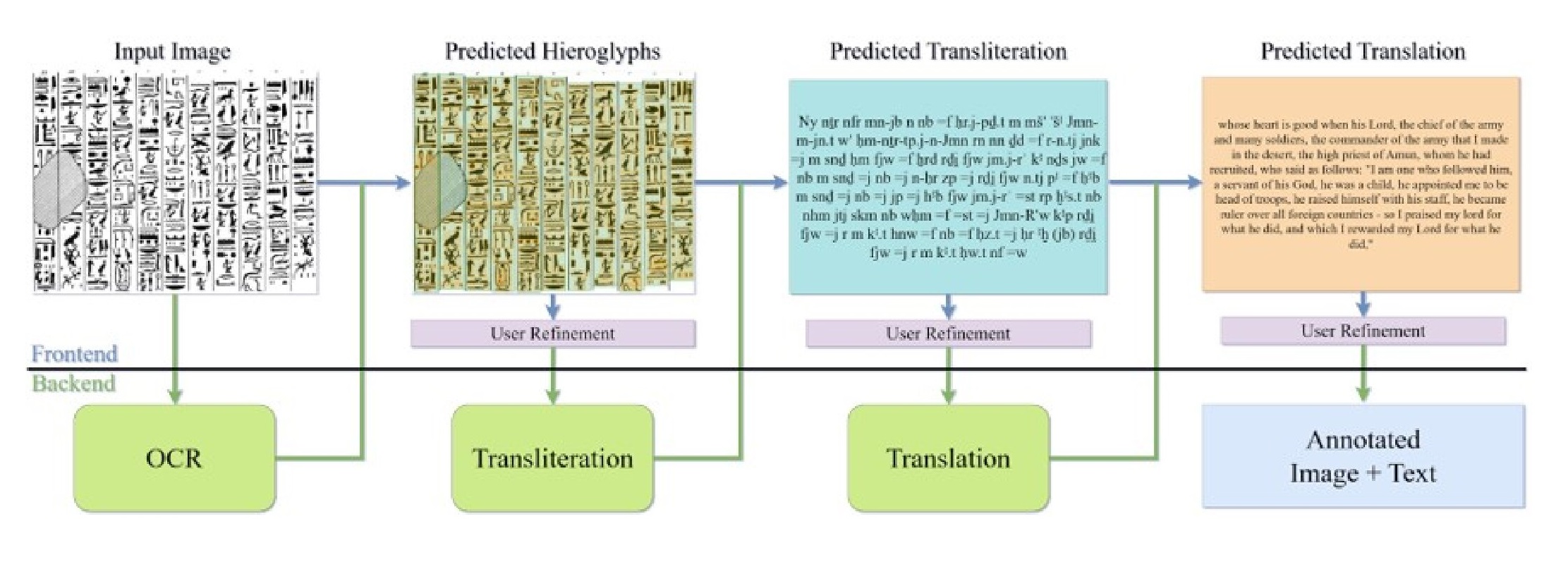
The paper, "Human-in-the-Loop Egyptology: A System for Ancient Egyptian Text Study," presents a prototype web application that takes a photograph of a hieroglyphic inscription and produces three linked outputs: Gardiner codes, transliteration, and English translation. A deep-learning pipeline generates an initial draft at each stage, and the scholar can inspect, correct, and re-run any step in an interactive workspace — keeping expert judgment central while removing much of the routine lookup effort that slows traditional work.
In a formative user study with eight Egyptologists and students, participants using the system completed the same tasks in 48 minutes instead of 60, and produced higher-quality recognition, transliteration, and translation than the manual baseline. The authors see the prototype as a step towards everyday, out-of-the-box AI assistance for Egyptological practice and teaching.
The paper extends the British–Russian partnership first reported in 2025, when Dr Alex Loktionov and Dr Ekaterina Alexandrova published the first joint British–Russian Egyptology article in the 200-year history of the field (Journal of the Economic and Social History of the Orient, 2025). This new study marks the collaboration's first appearance at a leading computer-science venue and brings AI researchers into the partnership for the first time.
Dr Ilya Makarov (AXXX & Trusted AI Center, RAS), who leads the AI/ML side of the project, said:
"Our goal was never to replace the Egyptologist. The most interesting finding is that a scholar working with AI draft suggestions produces better results than either the model or the scholar alone — the system reaches its best performance precisely when expert judgment stays in the loop. That, for us, is what human-centred AI should look like."
Paper
Humonen, I., Golyadkin, M., Rubanova, V., Alexandrova, E., Loktionov, A. A., & Makarov, I. (2026). Human-in-the-Loop Egyptology: A System for Ancient Egyptian Text Study. In Extended Abstracts of the 2026 CHI Conference on Human Factors in Computing Systems (CHI EA '26), Barcelona, Spain. ACM.
DOI: 10.1145/3772363.3798955
https://dl.acm.org/doi/10.1145/3772363.3798955